Finger Knitting vs Needles for Chunky Knits
 By Fernando Santos
It might be the question I’m asked most, on Etsy and in messages, almost daily: should I finger-knit this, or use the big needles? My honest answer runs both ways, and it includes the catches nobody warns you about.
Before anything else: do whatever speaks to your soul. There genuinely isn’t a wrong answer here, only the method you’ll actually enjoy and stick with. But since you asked properly, this is everything I’ve learned doing both.
Finger knitting: the easy, joyful way in
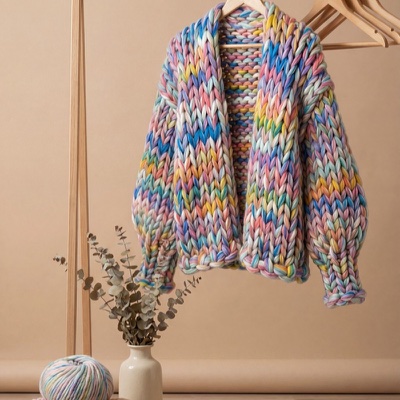
Finger knitting is the gentler start, no question. Because you’re working back and forth with your hands, you never have to wrestle with ‘the wrong side’ to purl; it’s all one friendly, repeating motion. Colour changes are easy. Intarsia (those blocks of colour) is easy too, which is half of what makes a Gigante cardigan look like a Gigante cardigan.
Two things that’ll make it go smoothly:
- Keep your balls of wool in order as you knit, and move them around as the colour blocks progress. A little bit of housekeeping row by row saves you a tangled nest later.
- Use your fingers as a gauge: each loop should be roughly the width of your two fingers. That’s your stitch size sorted, no needle required.
- Let each loop ‘kiss’ the last one. As you go, keep the loop you’re starting snug against the one you’ve just finished. It builds that lovely chain-like effect, and it helps consistency enormously, because the eye follows the neat chain instead of catching every little zigzag of uneven tension.
The catch with finger knitting
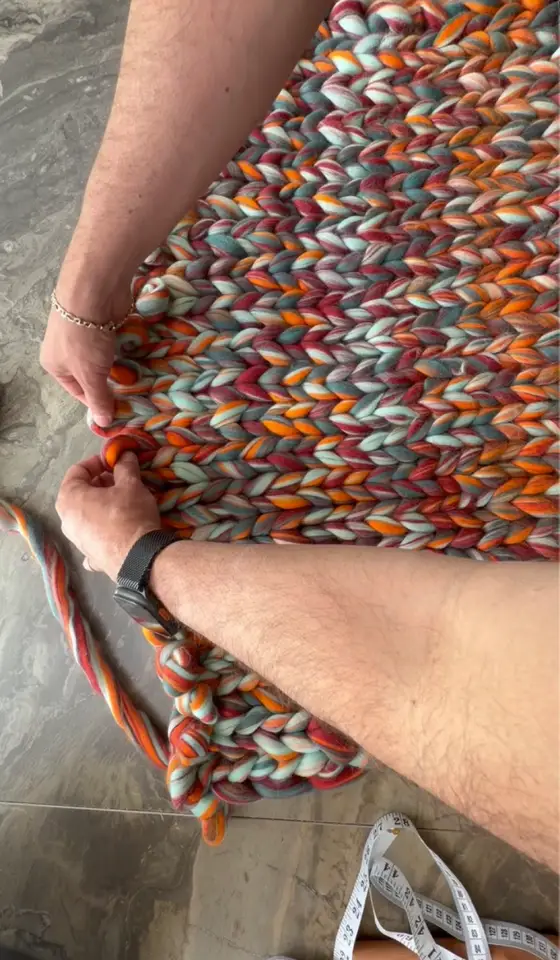
Finger-knitted stitches have a habit of looking uneven, and there is nothing more off-putting than a chunky garment that looks messy. Especially if, like me, you’re a bit of a perfectionist who clocks every wonky loop. I frog projects (unravel and start again) more often than I’d like to admit, purely because the stitches weren’t sitting right.
The best defence is simply to stop and look. It’s so easy to get carried away, so sense-check your stitches every row, and ideally every five stitches or so. If your loops have been consistent and one starts misbehaving, catch it now: build on top of a wonky stitch and you get a chain reaction of wonky stitches, all from one tiny mistake you could have fixed in a second. Leave it and, like me, you’ll end up frogging the whole lot. Ask me how I know.
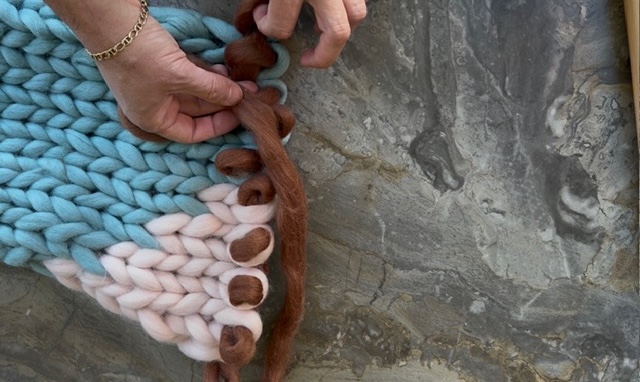
The trick I swear by is keeping one of the big 25mm single-pointed needles to hand (you’ll find them on my needles page). Once you’ve worked a row with your fingers, slip the stitches onto the needle to hold them even and consistent while you carry on. It’s a touch more work, but it pays for itself in a finish that actually looks deliberate rather than accidental.
Knitting with the big needles: the professional finish
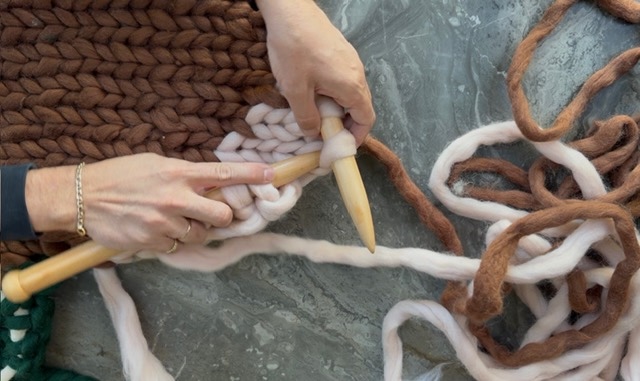
If consistency is what you’re after, needles win. The stitches line up, they look fantastic, and the finished piece reads as properly, professionally made. When a stranger stops you in the street to ask where you got your cardigan, this is usually why.
Two habits make all the difference here:
- Watch your tension: give every stitch an extra pull. As you form each one, draw it that little bit more. That’s what gives chunky its lovely airy, relaxed look and feel. There’s nothing more off-putting than stitches crammed together, holding on for dear life.
- Use circular needles, not single-pointed. I adore a single-pointed needle, but a growing cardigan needs room. The cable on a circular needle takes the weight, gives your piece somewhere to go, and means your loops won’t slide off the end while your back is turned. (Keep the single-pointed for the stitch-holding trick above.)
Finger knitting is the kinder learning curve; needles give the better finish. Both make a real cardigan.
The catch with needles
But, and it’s a genuine but, as the garment grows it gets heavy and unwieldy. Halfway through a body panel you’re holding something roughly the size of a small country, and turning it over to work the right and wrong sides becomes a real arm workout. Truth be told, my wrists ache some evenings. And needles are not your friend on sleeves: big needles and small surfaces simply don’t get along.
My one real recommendation: a knitting corner
If you can possibly manage it, give yourself a knitting corner, even if it’s just a cleared kitchen table. Chunky is so much easier to work flat, because the surface carries the weight instead of your wrists. Yes, it’s a bummer: knitting and telly go together beautifully, and a table compromises that cosy combination. But prop the piece on a coffee table, an arm of the sofa, anything that takes some of the weight, and you really can have both.
So… which one?
Truly, there’s no right or wrong. Chunky knitting is inclusive, beautiful and bold, and the best version of it is whichever method you’ll be comfortable doing and happy looking at. Brand new? Start with your fingers and a relaxed expectation. After that crisp, made-it-myself finish? Pick up the needles. Or do what I do most days and use both: fingers for the joy of it, the needle for the tidy.
If you’re right at the very beginning, start here: Can a Beginner Knit a Chunky Cardigan? Where to Start, Honestly It’s the gentlest way in I know. And when you’re ready for the big needles, mine are here, including the 25mm single-pointed ones I use for that stitch-holding trick.
Whichever way your hands take to it (fingers, needles, or a happy mix of the two), pick the one that feels good, and make something Gigante.
Keep reading
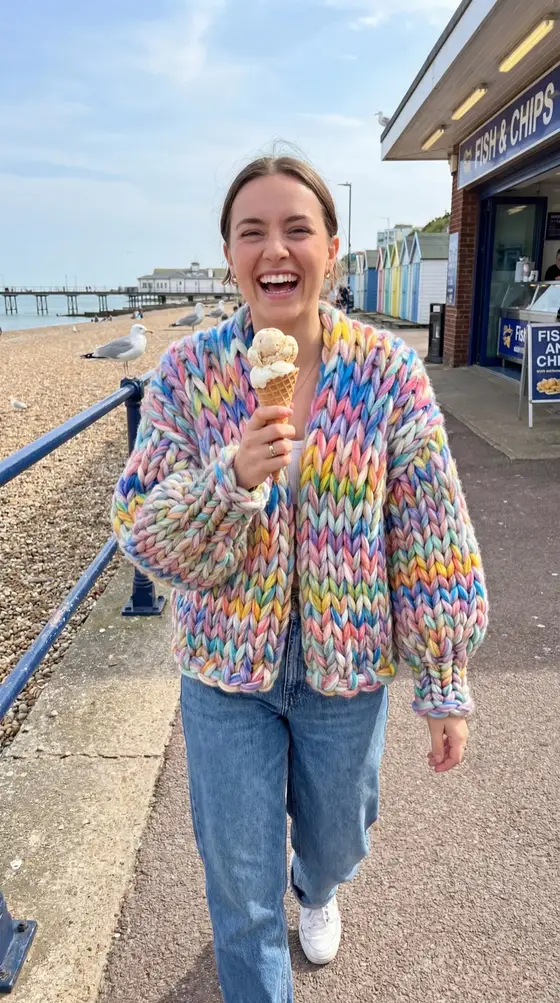
Can a Beginner Knit a Chunky Cardigan? Where to Start, Honestly
Big stitches are forgiving and fast, so chunky is the best place to start.
Read it next →