Why Does Chunky Knitting Curl at the Edges?
 By Fernando Santos
You finish a few rows, lay your work down to admire it… and the edges quietly roll themselves up like a scroll. Before you unpick a single stitch, stop. You haven't done anything wrong.
It's one of the most common worries I hear from people new to knitting, and the answer is reassuring: curling edges are normal. They aren't a sign of a dropped stitch, the wrong needles, or a personal failing; they're simply what a certain kind of knitting does, all by itself. Once you know why, it stops looking like a fault and starts looking like physics.
First, the good news: it's not a mistake
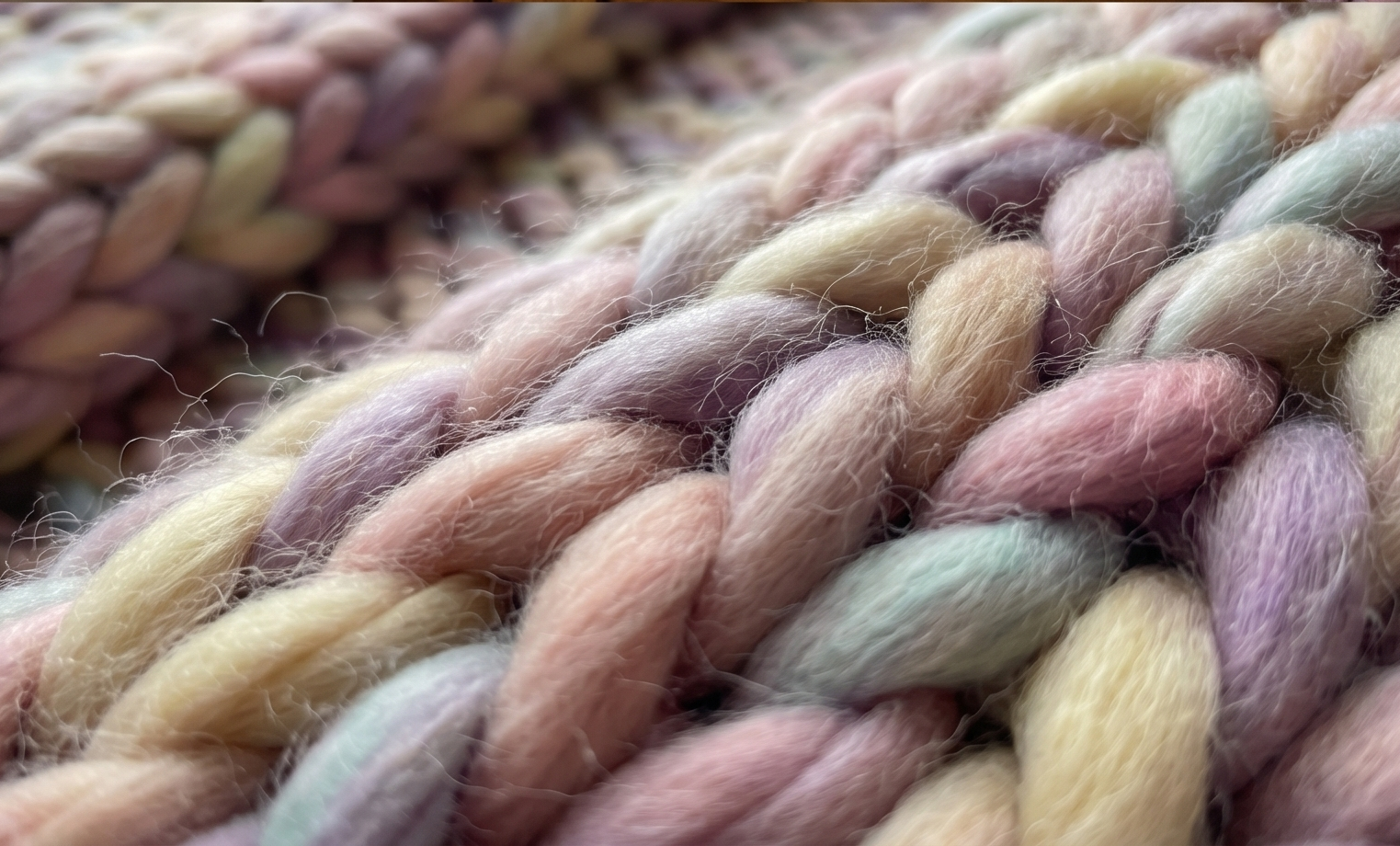
Most plain knitting, the smooth, V-shaped surface knitters call stockinette (every stitch knitted on the front-facing rows), curls at the edges. Always has, always will. Even an experienced knitter with thirty years behind them will watch a fresh stockinette swatch roll up the moment they set it down. So if yours is doing it too, congratulations: you're in excellent company, and your tension is probably just fine.
Curling isn't a flaw in your knitting. It's the fabric telling you what it's made of.
So why does it happen?
Here's the simple version. A knit stitch isn't flat; it's a little loop with a front and a back, and those two faces don't pull with equal force. The smooth side wants to lean one way; the bumpy side wants to lean the other. Stack hundreds of those tiny tensions together and the whole piece gives in to them at the edges, where there's nothing holding it open.
The top and bottom tend to roll toward the bumpy back; the left and right tend to roll toward the smooth front. It's the fabric quietly trying to balance itself. The middle of your work stays flat because the stitches around it hold it steady; it's only the unsupported edges that curl. That's also why a bigger piece curls less in proportion: there's more calm centre and relatively less restless edge.
How to stop it (the honest options)
There's no magic trick, but there are a handful of reliable fixes. Which one you reach for depends on what you're making.
1. Give it a flat-by-design border
For pieces with exposed edges (scarves, blankets, cowls, dishcloths), the classic answer is to frame the work in a stitch that doesn't curl. A few stitches of garter stitch (knit every row) or seed stitch (alternating knit and purl) around the border balances those competing tensions and lies obediently flat. Three or four stitches on each side is usually plenty. It's not a workaround so much as a design choice, and a handsome one, because a tidy border makes a simple scarf look properly finished.
2. Block it
Blocking is the quiet hero of hand-knitting, and it's the step beginners most often skip. All it means is gently wetting or steaming the finished piece, easing it into shape, and letting it dry flat, which relaxes the stitches and lets them settle into a calmer arrangement. With thick wool I keep it gentle: a light hover of steam from the iron (never pressed down hard on the stitches), or a soft wet-block where you dampen the piece, pat it into shape, and leave it to dry on a flat towel. Don't wring it, don't hang it. Chunky wool holds its blocked shape beautifully once it's dry; it's well worth the patience.
3. Let the weight do the work
This is the part I love about working big. A fine, lightweight knit has almost nothing to anchor it, so it curls enthusiastically. Chunky knitting is the opposite: the fabric is so substantial that its own honest weight helps it drape and hang straight, especially once it's a whole garment rather than a small loose swatch. Gravity becomes your assistant. A heavy chunky panel simply has less inclination to roll than a wisp of fingering yarn ever could.
What about our cardigans?
Here's where I want to be completely straight with you, because there's a myth worth clearing up. A lot of patterns fight curling with ribbed hems and cuffs: that stretchy, corrugated edge you see on most jumpers. Our chunky cardigans don't use ribbing at all. They're knitted in smooth stockinette from top to bottom, on purpose, because that big clean stitch is the whole look.
So how do they sit so well without a ribbed edge? Two reasons. First, that heavy chunky fabric we just talked about: its weight keeps the cardigan hanging cleanly rather than rolling up. Second, the construction: each edge is part of a whole garment, supported by the panels around it and steadied with a gentle block, not left as a lonely swatch edge. The result drapes the way it should, without pretending to be something it isn't. If you'd like to see how that comes together, our step-by-step guide to knitting a chunky cardigan walks through the whole thing.
Borders, then, are a tool for flat pieces (the scarf, the blanket, the throw), where an edge is meant to be seen on its own. For a garment, weight and construction do the quiet work instead.
Don't panic mid-project
One last reassurance: if you're partway through something and the edges are curling like mad, resist the urge to start over. Mid-project curl tells you almost nothing about how the finished piece will behave; plenty of knitting looks unruly on the needles and settles into something lovely after a wash and a block. Trust the process. And if you're brand new to all this, you might enjoy whether a complete beginner can knit a chunky cardigan (spoiler: yes, and the big stitches make it far more forgiving than it looks).
Curling edges are knitting being knitting. Now that you know the why, you can decide what to do about it, or, half the time, simply let the wool sort itself out.
Whenever you're ready to make something, there's a way in that suits you:
Keep reading

The Six Steps to Knitting a Chunky Cardigan (Only Two Are Hard)
The full step-by-step, and proof that smooth stockinette sits beautifully without any ribbing.
Read it next →