Dear Gigante: Why Not Make Chunky Blankets?
 By Fernando Santos
“Dear Gigante, honest question: why don’t you make chunky blankets? That is what giant wool is for, surely. And while you are at it, winter socks and gloves. I would buy those tomorrow.”
Honest question, honest answer, and I am going to show you the arithmetic rather than talk around it. Where I have landed: no blankets, yes to the small winter things, and it is the same reason for both.
A blanket is not a bigger cardigan. It is three or four cardigans
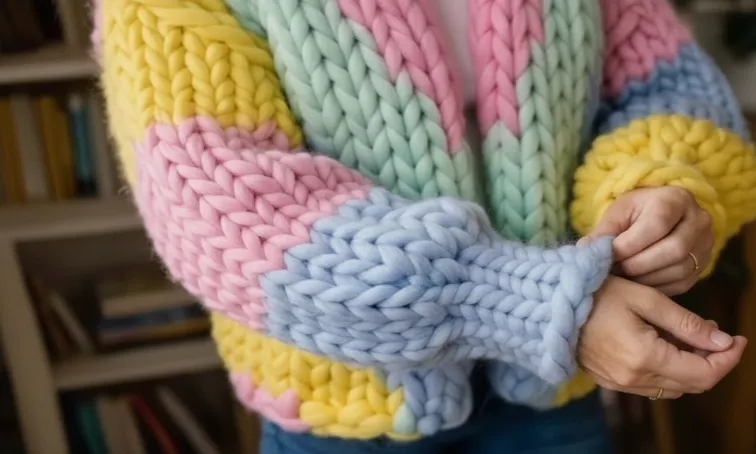
You can do this sum straight off our size guide, so let us do it. A Regular M cardigan is a back 20 stitches wide by 27 rows, two fronts of 9 by 27, and two sleeves. That back is 64cm across and 62cm long, and the whole garment comes to about 1.1 square metres of knitted fabric, nearer 1.3 with the fuller balloon sleeves most of our patterns use.
Now the blanket. A single bed is 150 by 200, so 3 square metres: getting on for three cardigans. A double bed is 200 by 220, so 4.4, which is three to four of them. Even the modest throw people usually picture, 130 by 170, is two cardigans. And every one of those metres is knitted by hand, stitch by stitch.
Three or four times the wool, three or four times the hours, and nothing about writing a cleverer pattern changes either. In giant knitting the wool is not one ingredient among many, it is nearly the whole bill, so a blanket lands at several times the price of a cardigan and stays there.
And the cardigan is the one you can wear every winter for years. That is the part I keep coming back to. If I am going to ask you for that much wool, I would rather it became something you put on.
A blanket priced honestly would be the most expensive thing on the site by a distance, and I would not pay it myself.
“Then use cheaper wool”
Easier said. I have looked, properly, more than once.
Corriedale and merino roving are simply expensive at source, especially in the quantities a two-person studio buys. My supplier minimum is 10 kg per colour, so a restock is a real commitment, not a click.
What I can tell you is where our price sits. Every time I check ours against UK suppliers, we come out lower. You can find a cheaper price per kilo from shops in Turkey and Eastern Europe, and plenty of people do. Then the delivery lands. Wool this bulky is expensive to ship, the quotes vary wildly from one order to the next, and by the time it arrives the saving has usually gone, sometimes twice over.
At the other end of the shelf there are lovely high-end names charging two or three times what I charge for something comparable. I have genuine respect for them: bigger studio, bigger overheads, a name people are glad to pay for. I just do not want what you pay to depend on any of that.
What a handmade price actually has in it
Price is not weight times a margin. If it were, I could make the number look smaller by doing less, and you would feel exactly where I had cut.
Every gram is hand-prepped before it reaches you. I buy the wool in big unspun rolls, smooth each length twice, split it lengthwise, comb it through by hand twice so the fibres lie straight, humidify it so they settle, then roll it into even bundles. That is hours per order, and it is the difference between roving that behaves and roving that fuzzes.
Then there is everything that never meets the eye. The emails answered, one at a time. The long conversation with someone deciding between two colourways. The sizes talked through. The pattern written, tested and rewritten. The box packed, and the walk to the post office with it. That work is real, it takes time, and it is in the price whether or not anyone lists it.
It also decides where your money goes. Order from a corporation and your order is a rounding error in a quarterly number. Order here and it is the thing that pays for the next 10 kg of a colour, keeps a small studio going, and lands on a table in Worthing. Small studios live on orders. That is not a guilt trip, it is just what is true.
Deliveries, and why I would rather quote you longer
Delivery is where a lot of shops quietly get their money back, and where a lot of buyers get let down. So, plainly: UK delivery is free over £30. Everything is posted within 7 working days, usually sooner. It then takes around 2 to 3 working days in the UK and 7 to 10 internationally, and those transit times are Royal Mail’s rather than mine, which is why I quote them separately.
Here is the decision I made that costs me sales. When a shade is not on my table, I will not pretend it is in a box. I would rather show it as sold out, or quote you a longer wait, than take the order and go quiet for three weeks while I chase 10 kg from a supplier. A slower honest date beats a fast fictional one every time, and you can plan around the first one.
And no, not acrylic
This one has its own letter, so I will keep it short here: acrylic is genuinely good at some things and I am not sniffy about it. But this whole thing is built on plush natural fibre, so swapping it in is not a discount, it is a different company. That aisle is also crowded and thin on margin, so I would be doing worse work for less money. The full answer, snobbery story included, is in the acrylic letter.
The part of your idea I am keeping, minus the gloves
Small and cheap is exactly right. Gloves, mittens and socks are not, and I want to be straight about why rather than sell you a novelty. Our stitch is roughly 3cm across. Fingers, thumbs, heels and toes are all small-stitch problems: at this scale they come out lumpen and gappy, and a giant-knit sock is a photograph, not a sock. Some things simply do not survive being scaled up, and that is three of them.
What does work is anything where the big stitch is the whole point and nothing needs fine shaping. A cowl. A scarf. A headband. A cushion cover. A bag. A Christmas stocking, which is meant to be comically oversized, so giant wool suits it better than anything else in the house.
That is where the arithmetic flips. Each of those is around one 500g bundle, sometimes two, so £26 or £52 of wool instead of a blanket’s several hundred, and an evening or two instead of a fortnight. Cheap enough to make for somebody else, which is what winter is for. Better still, a cardigan usually leaves you enough for one of them: if you have a bag of ends in a cupboard, this is what leftovers turn into.
Where that leaves us
No blanket, then. Not because it would be difficult, but because I would have to charge an amount I could not look you in the eye about. If you want one anyway, the honest route is to buy the wool and knit it yourself, and I will happily help you get the amount right: the wool maths is here.
The small winter pieces are what I am sketching for this winter. Nothing has a date yet and I will not invent one. But if you tell me which you would want first, the stocking, the cowl or the cushion, that genuinely decides the order I make them in.
Keep reading
The Chunky Wool Maths That Stops You Buying Too Many Balls (or Running Out Mid-Sleeve)
Ballpark amounts for a scarf, a throw and a cardigan, and what makes the number go up or down.
Read it next →