What Size Needles for Chunky Wool?
 By Fernando Santos
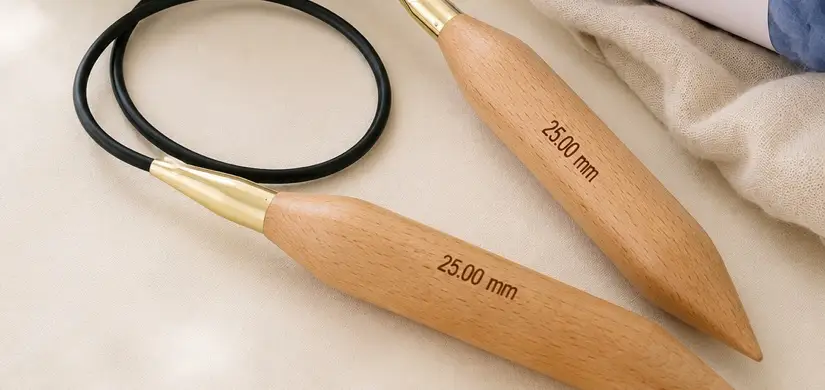
If you came here for one number, here it is: 25mm. That is what our patterns are written around, and it is what almost everybody knitting Gigante Wool ends up using. If you are knitting with something else, or you want to understand why a needle size matters at all, the rest of this is for you.
The straight answer, by yarn weight
Chunky yarn is not one thing. It is a whole family, and the gap between the thinnest and the thickest is enormous, so “chunky needles” on its own means very little. Here is roughly where each weight sits:
| Yarn weight | Also called | Typical needle size |
|---|---|---|
| Chunky | Bulky, 12 ply | 6 to 8mm |
| Super chunky | Super bulky, 14 ply | 9 to 12mm |
| Jumbo | Roving, unspun top | 15mm and upward |
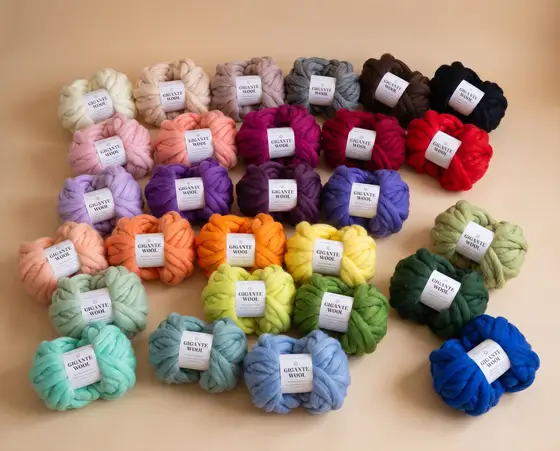
| Gigante Wool | Oversized roving | 25mm |
Notice how far our wool sits past the end of an ordinary chunky range. That is the whole point of it. Gigante Wool is oversized roving, thick and barely twisted, and on 8mm needles it would come out as a solid slab you could not bend, let alone wear.
What actually changes when you change needle size
Same wool, different needles, genuinely different garment. It is worth knowing which way each direction pushes you.
Smaller needles give you tighter, denser, stiffer fabric. It holds its shape well and it is warm, but it takes longer, it uses more wool, and past a point it stops draping and starts behaving like board.
Bigger needles give you looser, softer, more open fabric that drapes and moves. It knits up faster and uses less wool. Go too far and the stitches lose definition and start to sag under their own weight, which with giant roving happens sooner than you would think.
Needle size is not about right and wrong. It is the dial between armour and a puddle.
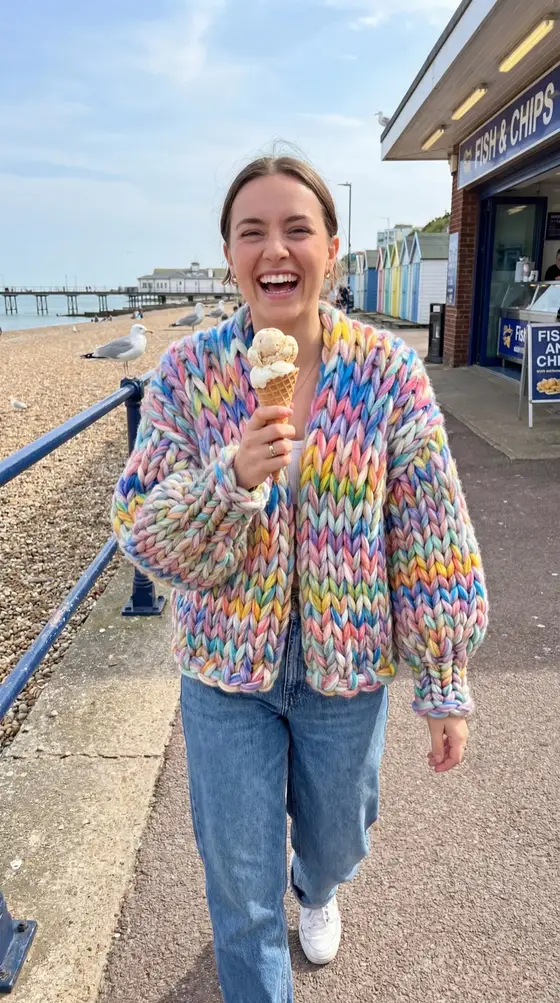
For an oversized cardigan you want to land in the middle of those two: open enough to drape over the shoulders, firm enough that a giant stitch still stands up and looks like a stitch. On our wool, that is 25mm.
What our patterns ask for
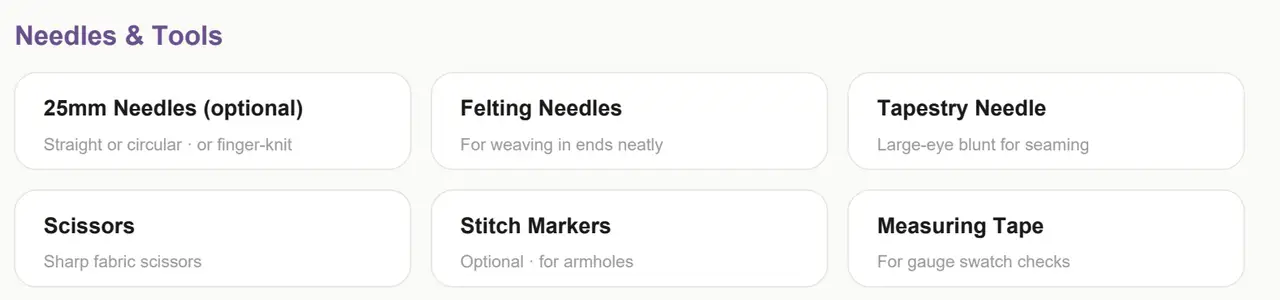
Every Gigante pattern lists 25mm needles, straight or circular, and you will notice we mark them optional. That is not a typo. Our wool is thick enough to knit with your hands alone, and plenty of people do. More on that at the bottom.
The rest of that list is short and worth having: a felting needle for weaving ends in properly, a large-eye tapestry needle for seaming, sharp scissors, a couple of stitch markers for the armholes, and a tape measure for checking your swatch.
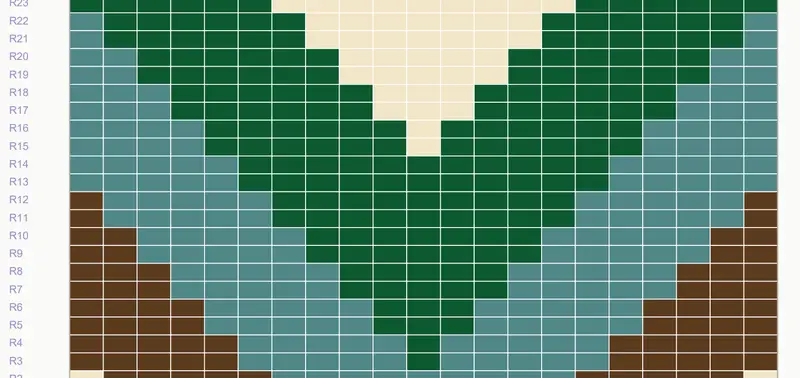
That page comes to you twice, by the way. Every Gigante pattern includes both the printable PDF you can see above and a digital construction guide that opens on any phone or laptop, with the charts on screen and a Row Ruler that holds your place between sittings. Print one, knit from the other, whichever suits you on the day.
Every pattern also comes with the masterclass: a video where I take you through the basics from the beginning. If you have never held a needle this size, or you have never knitted at all, that is the place to start. You can watch me do a thing before you try it, which is worth more than any amount of writing about it.
Circular or straight? It depends which piece you are on
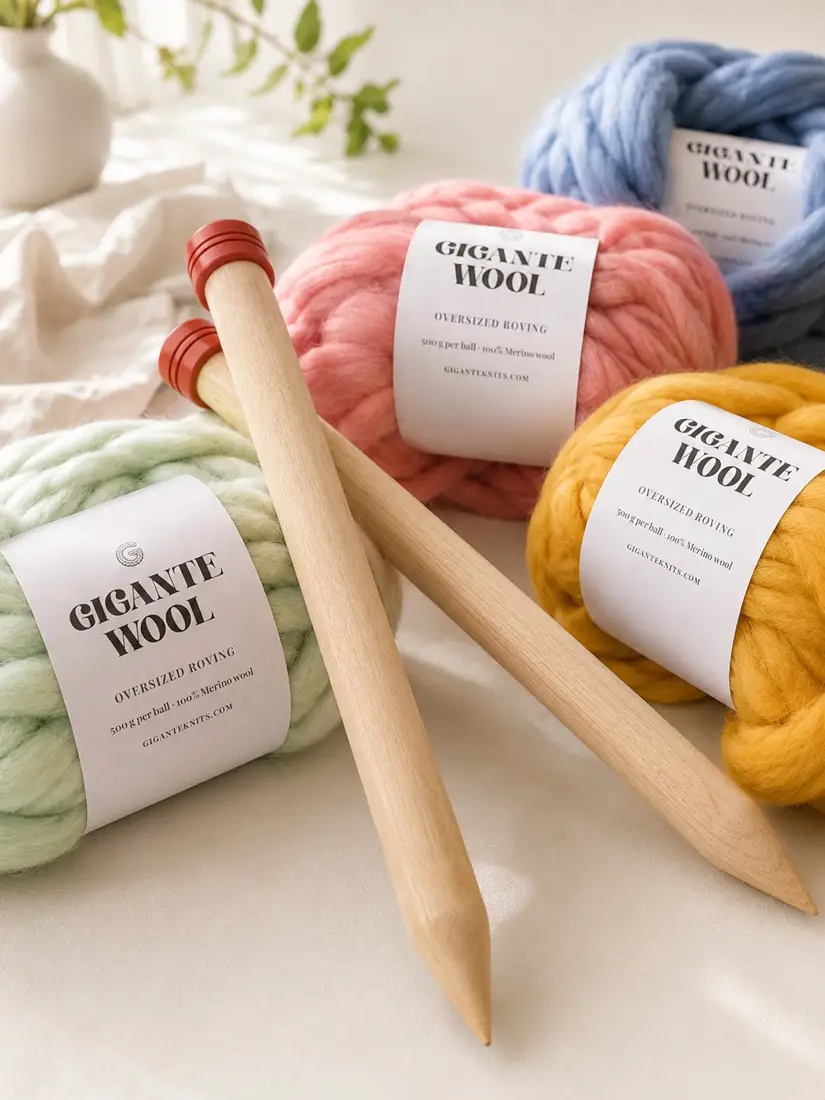
This usually gets framed as a comfort question, and at this scale it is not. It is a question of whether your stitches physically fit on the needle. The honest answer is that a cardigan wants different things from you at different stages.
The back panel needs the cable. The back is the widest piece in the whole cardigan and the heaviest, and it gets heavier every row you add. A circular needle is two tips joined by a flexible cable, and that cable is doing the real work: it carries the entire row of stitches safely along its length while you knit. A straight pair simply will not take the full width of a chunky back panel. There is no room on them. So for the back, circulars are not a preference, they are the tool for the job.
The front panels are perfectly happy on straights. Once you are past the back and working the panels, each row is far narrower, and that width sits comfortably on a single-pointed pair. If you like the feel of classic straight needles in your hands, this is where they come into their own.
For the sleeves, I would use my hands. A sleeve works on a small number of stitches in a tight space, and needles are genuinely awkward in there. Not enough room to move. I would highly recommend finger knitting the sleeves instead: you get far more control and nothing to fight against.
Circulars for the back, straights for the panels, fingers for the sleeves. One cardigan, three answers.
We make both kinds in beech and birchwood, in 20, 25, 30 and 35mm. They all live on the needles page.
Your swatch overrules everything above

Here is the honest part. Everything I have written so far is a starting point, and the only thing that actually decides your needle size is a small square of knitting you make yourself.
Knit a swatch roughly 10cm by 10cm in the wool you are going to use. Let it relax, then count how many stitches and rows fit across it and compare that against the gauge printed in the pattern. If your stitches are coming out bigger than the pattern expects, go down a needle size. If they are coming out smaller, go up.
Some of us knit tight and some of us knit loose, and neither is a fault. Two knitters can follow the identical pattern on identical needles and finish a full size apart. The swatch is simply how you find out which one you are before you have made a whole cardigan in the wrong size. I know which way I would rather find out.
Or use no needles at all
I have just recommended fingers for the sleeves, and it is worth saying that you can go further than that: our wool is thick enough to knit the entire cardigan with your hands. It sounds like a novelty and it genuinely is not. Finger knitting is fast, surprisingly meditative, and there is nothing to drop. It gives a slightly looser, softer fabric than needles do, which suits some designs beautifully.
I have set the two side by side, honestly, in finger knitting versus needles, including the things each one is genuinely worse at.
Not sure which size suits what you have in mind? Send me a message with the yarn you are using and I will tell you what I would put it on.
Keep reading
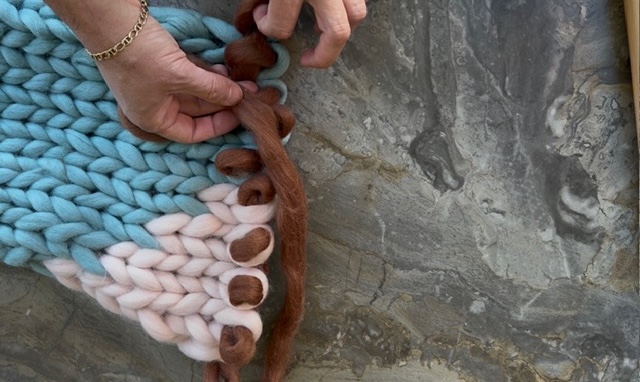
What Finger Knitting Fans and Needle Knitters Both Get Wrong About Chunky Knits
The honest pros and cons of finger knitting against big needles for a chunky cardigan.
Read it next →